 |
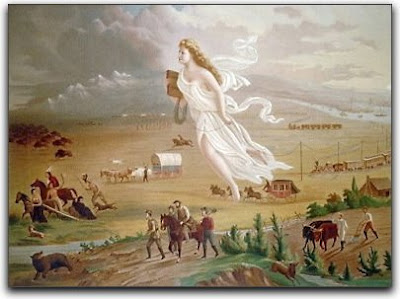
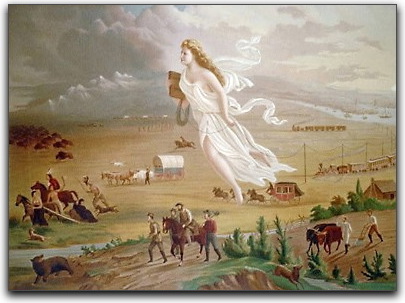
This Picture is a very important picture during the 1850's because it shows that we need to travel west and expand our land. We need to find new places and things and create new experiences by traveling west. When we do travel west it opens many doors to our society we find gold, silver, copper, and much more. This Picture is a example of manifest destiny, Many believed that God told them to travel west and follow her (the angel) and other just wanted to have a fresh start to a new life. |
|||
Social Chisholm Trail- to Abilene a town that when filled with cowboys at the end of a drive, rivaled the mining towns in terms of rowdiness. As the railroads expanded in the West, other trails reached from Texas to more towns in Kansas, Nebraska, Montana, and Wyoming. Ghost Dance- a ritual that Native Americans believed in. This celebrates a hoped day of reckoning when settlers would disappear, the buffalo would return, and Native Americans would reunite with their decreased ancestors. Nomads- someone who roamed vast distances, following their main source of food, the buffalo. Economic Barbed Wire- Used to keep the cattle in the land and it marks off where your land is. Mechanic Reeper- it plows the land and reaps what you've harvested Boom Towns/Ghost Towns- Used for gold and money, no one was or went there. Political Assimilate- To be absorbed into American society as landowners and citizens. Vigilance Committees- those who track down wrongdoers. Dawes act- This act allotted each head of household 160 acres of reservation land for farming; single adults received 80 acres, and 40 acres were allotted for children. This gave them farming land but also forced them onto reservation.
Is History a History of Progress?History was a history of progress in this era because at this time we have discovered so many new things due to curiosity and religion. If we had never gone to the west until later in life then we wouldn't of came as far as we are today. Not only was traveling to the west a great idea but by traveling there we ran into newer things like rich deposits of gold, silver, and copper by finding these riches it helped out the needs of industries in the east. Then many farmers wanted to go out west to start their own farms so for a registration fee of $10 you could file for a Homestead- a tract of public land available for settlement. When filed, a homesteader has the opportunity to claim up to 160 acres of public land and could receive title to that land after living their for five years. So many farms were made and over the years the farms eventually turned into factories, which created Industrialization/ Immigration/ and Urban America. |
||||